When I first started selling unequal length double end studs out of a small workshop in Michigan, I thought choosing the right ones would be straightforward—just pick the right size, thread count, and material, and that would do it. Within a month, a local tractor parts distributor called me in a panic. They’d ordered studs for a John Deere 6R tractor wheel, got standard-length ones, and now they had to take the whole wheel assembly apart three times a day to re-fit bolts. That call taught me a lesson: unequal length double end studs aren’t just another fastener. They solve specific, often hidden problems in industries from heavy equipment to automotive, and picking the wrong one can cost thousands in downtime. Over the past 12 years, I’ve helped hundreds of manufacturers, repair shops, and even home mechanics get this right, and today I want to share what I’ve learned—no fancy industry jargon, just real, hands-on advice. Unequal Length Double End Studs

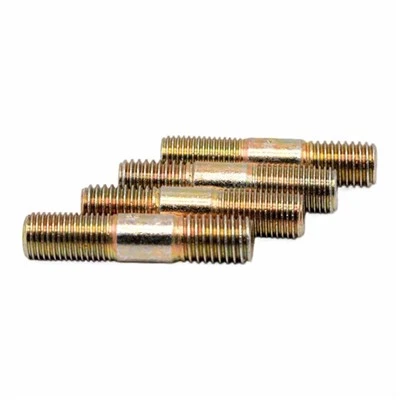
Let’s start with the basics, because so many people skip this and land in trouble. Unequal length double end studs are exactly what they sound like: a metal rod threaded on both ends, with one end longer than the other. You screw the shorter end into a threaded hole in a part, then use the longer end to mount a component—like a wheel, a brake caliper, or a gear housing. The point of the length difference is simple: it prevents cross-threading. If both ends were the same length, when you lined up the part you’re mounting, the bolt might start going crooked, stripping threads or putting stress that cracks parts. But the length has to be matched to the exact application. Too short, and the bolt won’t have enough thread engagement to hold tight. Too long, and it sticks out where it can get hit, or it doesn’t let the component seat flush. Take that tractor shop again: they used a 1.5-inch stud when they needed a 1.75-inch one. The shorter length meant the wheel was only grabbing two threads instead of three, so after 50 hours of plowing, the wheel bolts worked loose. By the time they called, they’d already replaced three wheels and a differential—all because of a 0.25-inch mistake. That’s why the first step is never guessing: pull out the old stud and measure it, or check the part’s service manual. If you don’t have the old one, measure the depth of the threaded hole, then add the thickness of the component you’re mounting. If that component is a 0.5-inch wheel hub, and the hole is 1 inch deep, you need a stud with a total length that lets 1 inch screw into the hole and 0.5 inch stick out to hold the wheel. Easy, right? But I still see guys skip this, because they think “close enough” works. It doesn’t.
Next up: material. This is where I see the most mistakes, and it’s not about being cheap—it’s about matching the material to the load. Most unequal length double end studs are made from three main types: carbon steel, alloy steel, and stainless steel. Carbon steel is the workhorse. It’s strong, it’s cheap, and it works for 90% of general applications—like mounting small engine parts, or holding together a trailer axle. But carbon steel rusts if it’s exposed to moisture or chemicals, like salt on roads or grease in a workshop. That’s where alloy steel comes in. Alloy steel has small amounts of chromium, molybdenum, or nickel added, which makes it harder and more resistant to heat and stress. It’s the go-to for heavy equipment, like bulldozer blades or construction cranes, where parts are under extreme load and heat. Last year, a mining equipment company came to me after their alloy steel studs kept breaking on a shovel bucket. They were using standard Grade 8 studs, but the bucket was hitting rocks hard enough to put 15,000 psi of tension on each stud. I suggested a Grade 10.9 alloy steel stud with a higher tensile strength, and they haven’t had a break since. Then there’s stainless steel. Stainless is for when corrosion is a big problem—like marine engines, food processing equipment, or parts that sit outside year-round. But stainless is softer than alloy steel, so it’s not for high-stress applications. I always tell people: don’t use stainless on wheel studs or engine mounts that take repeated vibration. You’ll end up stripping threads. If you’re not sure which material to use, ask yourself two questions: Will this stud be exposed to water, salt, or harsh chemicals? Will it be under heavy load or high heat? If both are no, carbon steel is fine. If one is yes, go to alloy. If both are yes, stainless is probably your best bet, just make sure you get a high-grade stainless (316, not 304) for extra strength.
Thread count is another part most people overlook, and it’s a small detail that causes big problems. Thread count is how many threads are per inch (for imperial) or per millimeter (for metric). A 1/2-13 stud means 13 threads per inch; a 1/2-20 means 20. Higher thread count means thinner threads, which is good for softer materials—like aluminum engine blocks, where thick threads can strip. Lower thread count is thicker, stronger threads, which is better for harder materials like cast iron or steel. A few years back, a race car builder brought me a set of broken wheel studs. They’d used 1/2-20 studs on their aluminum alloy wheels, but the wheel manufacturer specified 1/2-13. The higher thread count of the 20 stud stripped the soft aluminum wheel holes every time they ran the car at 100 mph around a track. Swapping to the lower thread count 13 stud fixed it instantly. That’s the thing about thread count: it’s not just about fitting. It’s about matching the two parts that the stud is connecting. If the part you’re mounting is soft (aluminum, plastic, thin steel), use a higher thread count to spread the load. If it’s hard (cast iron, thick steel, heavy equipment components), use a lower thread count for strength. And always double-check: don’t go by the old stud’s thread count alone, because sometimes the old one was a replacement that didn’t fit right. Measure the threads with a thread gauge, or cross-reference with the part number from the manufacturer.
Coatings and finishes are the unsung heroes of stud performance, and I see guys ignore them all the time. A good coating does three things: prevents rust, makes installation easier, and prevents galling. Galling is when two metal parts stick together because of friction—you torque a stud, and when you try to loosen it, it won’t move, or the threads tear apart. That’s a nightmare, especially in hard-to-reach places. The most common coatings are zinc, zinc-nickel, and cadmium. Wait, cadmium is less common now because it’s toxic, but zinc-nickel is a better alternative. Zinc is basic, stops light rust, but isn’t great for heavy use. Zinc-nickel is 10 times more corrosion-resistant than regular zinc, and it reduces galling. For a trailer that sits outside year-round or a farm truck that drives on salted roads, zinc-nickel is worth the extra few cents per stud. Another option is black oxide. Black oxide is a thin, black coating that’s great for reducing galling, and it’s cheap. It doesn’t stop rust as well as zinc, though, so it’s good for indoor applications or parts that get oiled regularly. I always tell people: if you’re installing studs in a place where you’ll need to remove them later (like a wheel or a brake caliper), get a stud with a coating that prevents galling. You’ll save hours of wrestling with stuck bolts, and you won’t have to damage the threads when you replace parts.
Now, let’s talk about something that’s specific to unequal length double end studs that a lot of suppliers won’t tell you: the shoulder. Wait, most people don’t even know a shoulder exists. A shoulder is the unthreaded part between the two threaded ends of the stud. For unequal length studs, that shoulder is critical because it’s what sets how far the component sits from the part it’s mounted to. If the shoulder is too short, the component sits too close, and you can’t get a wrench on the bolt. If it’s too long, the component sits too far out, throwing off alignment. A few months ago, a small engine repair shop came to me with a set of studs for a lawn mower deck. They’d bought a cheap set online, and the shoulder was 1/8 inch too long. When they mounted the deck, the blade hit the housing, bent the belt, and tore the blades. They had to pull the deck apart, grind down the shoulder on every stud, and lost two weekends of repair work in the busy spring season. That’s the thing about shoulders: it’s not just a random part. It’s designed for exact clearance. When you measure your old stud, don’t just measure the total length—measure the length of each threaded end, and the length of the shoulder. A lot of cheap studs cut corners by making the shoulder too long or too short, so even if the length matches, the stud won’t fit right. That’s why buying from a supplier that custom-makes their studs with exact shoulder measurements is better than buying a bulk pack from a big box store.
Wait, let’s circle back to applications, because every industry has its own quirks. For automotive: passenger cars usually use carbon steel studs with zinc coating. Performance cars or heavy trucks go to alloy steel, and sometimes stainless for wheel studs if they’re exposed to salt. For construction and agriculture: you need alloy steel studs, because they’re under heavy load, heat, and impact. Length here is extra important because equipment parts vibrate constantly—too short, and studs work loose over time. For marine: only 316 stainless steel studs, because salt water eats carbon steel alive. Thread count here is usually lower, because marine parts are thick cast iron or steel. For small engines and trailers: carbon steel, maybe with black oxide for galling resistance. Length is basic, because most trailer wheel studs are standard.
Now, a common mistake I see even experienced mechanics make is ordering the same studs over and over, without checking if the application has changed. A customer of mine, he runs a fleet of 20 delivery vans. For five years, he ordered the same wheel studs, and they worked fine. Then he switched to winter tires with heavier snow chains. Suddenly, studs were breaking every month on his front wheels. He didn’t realize that the extra weight and impact of the chains put 20% more load on each stud. He was still using the same Grade 5 carbon steel studs, when he needed Grade 8 alloy steel. That’s a big one: if you change the load, the environment, or the components you’re mounting, you have to change the studs. Don’t get stuck in a routine.
At this point, you might be thinking: that’s a lot to remember. I don’t want to measure every stud every time. So here’s my final piece of advice: work with a supplier you trust. I’ve been in this business long enough to know that not all unequal length double end studs are the same. A cheap stud from a bulk pack might have the wrong length, wrong thread count, or a thin coating that rusts in a month. When you work with someone who knows the product, they’ll ask you questions: what are you mounting? What material is the part? What’s the load? What’s the environment? They won’t just sell you the cheapest thing. That tractor shop I mentioned earlier? I didn’t just sell them the right studs. I walked them through how to install them, how to torque them to the right spec, and how to check them every 50 hours. A good supplier doesn’t just process an order—they solve your problem.
If you’re tired of dealing with broken studs, loose parts, and downtime that costs you money, let’s talk. Whether you need a single stud for a lawn mower, a bulk order for a fleet of trucks, or custom studs for a piece of heavy equipment, I can help you pick the right ones. Don’t guess—get the right studs the first time, so you don’t have to pay for repairs later.
Structural Nuts References
- Machinery’s Handbook, 31st Edition, Industrial Press Inc., 2020.
- Fastener Standards and Specifications, American Society of Mechanical Engineers (ASME) B18.2.1, 2021.
- Design and Selection of Fasteners for High Load Applications, Society of Automotive Engineers (SAE) International, 2019.
Handan Jihao Fastener Co., Ltd.
We’re known as one of the most professional unequal length double end studs manufacturers and suppliers in China. With abundant experience, we warmly welcome you to wholesale customized unequal length double end studs made in China here from our factory. If you have any enquiry about cooperation, please feel free to email us.
Address: A2, Row 31, Feiyu Screw World, Hebei Pu, Linmengguan Town, Yongnian District, Handan City, Hebei Province
E-mail: wenzhaona0@gmail.com
WebSite: https://www.chinaboltnut.com/
